Advanced Science Training: A Decade of Strengthening The Research Skills Of African Women Through Global Partnerships
Assessing the impact of the AWARD fellowship programme for women researchers.
This is was the first document I ever typeset using Adobe InDesign. Before this, I was using Illustrator as that was all I had but that was miserable for anything beyond a few pages.
The report was led by my dear friend Jodi Lilley, as part of an internships with African Women in Agricultural Research and Development (AWARD) investigating the impact of the ‘Advanced Science Training’ (AST) programme. This is one of the main training programmes that had been run by AWARD as part of their larger capacity building mission. It supported women across the continent in build research and leaderships skills.
The report was a fun one to typeset as it contained a nice mix of text, diagrams and pull quotes - all wrapped in the AWARD orange branding. All figures were made in Adobe Illustrator.
The AWARD logo is a bundle of sticks, drawing from an African proverb that a single stick can be broken, but a bundle together cannot be.
AWARD had a clear style guide that was a great asset to help me match the report design to be in harmony with AWARD’s other outputs.
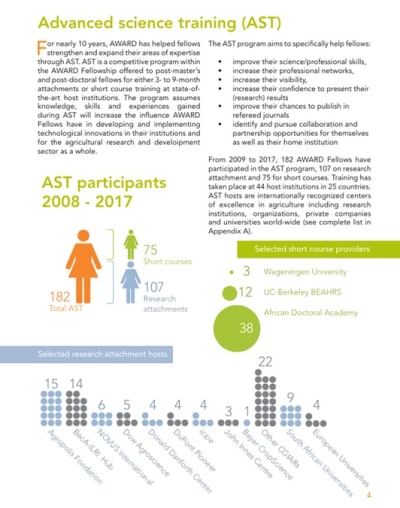
There are a few choices I made looking back that I would have changed but on the whole, I’m fairly happy with how this first attempt came together. I certainly never went back to Illustrator…
Here’s the blurb for the report:
Strengthening the scientific research skills of AWARD Fellows is a critical factor of the AWARD Fellowship, and Advanced Science Training (AST) is a key component of AWARD’s efforts to strengthen African women’s scientific research skills; AWARD Fellows are selected to participate in research placements with partner institutions around the world. This report is the first systematic analysis of the impact of AWARD’s AST. It also contains important lessons that would be valuable to anyone trying to replicate the AWARD Fellowship model? It highlights the importance of nurturing connections not just between individual scientists, in this case AWARD Fellows and their AST supervisors, but also catalyzing connections between their two research institutions.
The full report can be found here